Databricks
Builds the modern data foundation. One governed platform for data engineering, analytics and AI.
Most companies don't have a data shortage. They have a data scatter: sales in one system, operations in another, and a decade of history sitting in a warehouse nobody dares touch. Clay TechSystems pairs 18+ years of enterprise delivery with the Databricks Data Intelligence Platform to pull that scatter into one governed foundation, then puts analytics and AI on top of it, so the answer to a business question stops varying with who you happen to ask.
In a Nutshell
Builds the modern data foundation. One governed platform for data engineering, analytics and AI.
Turns that data into business insight. Dashboards, associative exploration and agentic analytics on trusted data.
Makes sure they work together, and with everything else you run. Integration, workflows, migration and the engineers to deliver it.
The Partnership
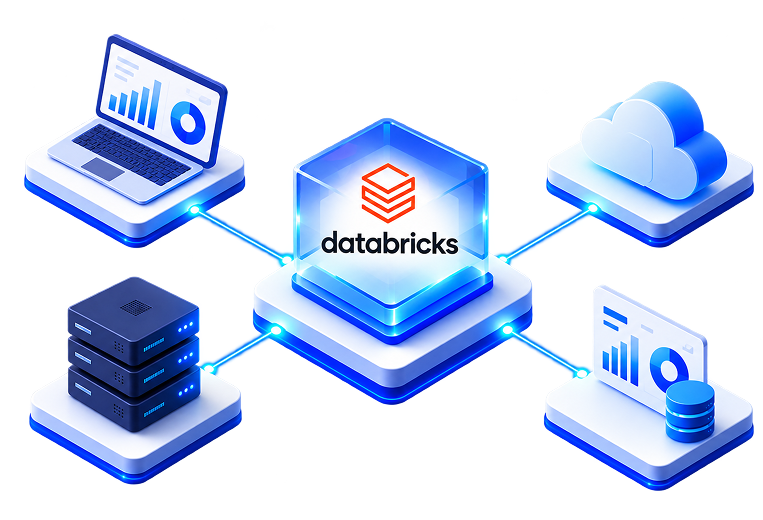
Databricks describes its Data Intelligence Platform as one place for data engineering, analytics and AI, with the lakehouse at its core, Lakeflow for pipelines, Unity Catalogue for governance, Lakebase for operational data and Agent Bricks for building agents. According to Databricks, more than 20,000 organisations worldwide run on it, including over 60% of the Fortune 500.
Lakehouse architecture
Structured tables, raw files and streaming data in one place, on open formats such as Delta Lake and Apache Iceberg.
Unity Catalogue governance
One place for access control, column-level lineage and audit logs across data and AI assets, including row-level and column-level security and policies that extend to models and agents.
Mosaic AI
Model serving, an agent framework and vector search for generative AI and retrieval-augmented generation on your own data.
Genie
Natural-language questions answered from governed lakehouse data, so a manager doesn't need SQL to get an answer.
The part a platform can't ship: delivery. A lakehouse is a capability. Making it work inside a real organisation, with real legacy systems and real deadlines, is an engineering and consulting job.
What the Pairing Changes
A single governed source replaces the pile of competing spreadsheets and extracts. The number nobody trusted yesterday becomes the number everyone quotes today.
Quality checks, lineage and access policies sit in the pipeline from day one, so a forecasting model or an assistant is never trained on data nobody has vouched for.
The dashboard a CFO reads and the model data scientists train read from the same governed layer, which removes the drift that creeps in when each team keeps its own extract.
A threshold crossed in the lakehouse can trigger a workflow in ServiceNow or an alert to the right owner. That last mile is where Clay's platform and integration work earn their keep.
Compute sizing, workload separation and cost monitoring are set up alongside the architecture, rather than retrofitted after the first surprising cloud bill.
In Practice
Databricks isn't a standalone line item at Clay. It is the engine inside four of Clay's services, each paired with the partner that fits the job.
Talend and Databricks, on GCP or alongside Snowflake. Databricks runs on AWS, Azure and Google Cloud, so the lakehouse sits where your cloud already is. Qlik Talend Cloud delivers data into Databricks, Snowflake and Google BigQuery alike.
Explore Data Integration & Engineering
Unity Catalogue is one control point for access, lineage and audit across data and AI assets. Talend's data quality scoring checks the data before it arrives. Governance is built into the pipeline rather than written up afterwards.
Explore Data Governance
Qlik, Talend and Databricks. Legacy warehouse to lakehouse, with the Qlik analytics layer re-pointed at the new Gold tables so business users see the same dashboards, now faster and better governed.
Explore Migration
Qlik Sense reads from Databricks SQL warehouses, and Databricks Genie and Mosaic AI work on the same governed data, so dashboards and AI assistants never disagree.
Explore Business Intelligence & Agentic AI
Underneath all four: training and consulting to get your team fluent, and staff augmentation to put specialist data engineers alongside them.
The Architecture
Data doesn't arrive analysis-ready, and it shouldn't be forced to. Clay builds Databricks environments on the medallion pattern: three layers of progressively better data, with AI-assisted pipeline development speeding up the routine work at each stage.
Layer 01
Land everything, lose nothing
Raw data from ERP, CRM, mainframe, SaaS and streaming sources lands as-is, including change-data-capture streams, so there is always an untouched record to go back to.
Layer 02
Clean, conform, validate
Duplicates resolved, formats standardised, business rules and quality checks applied. This is where "customer" finally means one thing across six systems.
Layer 03
Business-ready
Curated, governed tables shaped for the questions the business actually asks. Gold feeds Qlik dashboards, machine learning features and natural-language querying.
The Partner Stack
Clay's partner ecosystem isn't a logo wall. It's a route your data actually travels.
SAP, Oracle, mainframes, relational databases, SaaS applications and IoT feeds.
Ingest and validate. Qlik Talend Cloud automates streams from transaction systems into Databricks, and Qlik Replicate can stream continuous change data into Unity Catalogue tables.
Refine, govern, learn. Bronze, silver and gold layers, Unity Catalogue governance, and Mosaic AI on top.
Explore and decide. Qlik Sense connects to Databricks SQL warehouses, including direct query for large or near-real-time data.
Act. Insights become tickets, approvals and workflows through Clay's integration and API layer.
The AI Layer
The reason to get the foundation right is what it makes possible on top: Databricks analytics and AI that answer from governed data rather than guesswork. The order matters: governed data first, AI second.
With Databricks Genie, a compliance officer or regional manager asks a question in plain English and gets an answer from governed data, with Unity Catalogue permissions still applying.
Mosaic AI's agent framework and vector search let assistants answer from your documents and tables, instead of from whatever a general model half-remembers.
Agent Bricks and Clay's workflow integration point toward AI that doesn't only report a problem but also routes it.
Clay's chatbot practice has already built an AI analytics chatbot over a telecom enterprise's unified data layer. A governed lakehouse is the natural home for that pattern at a larger scale.
Reference Architectures
These are Clay-designed architecture patterns, shown so you can see how we think. They are blueprints, not customer deployments.
Blueprint 01
For estates where the warehouse is expensive, slow to change and fragile. Databricks' free migration toolkit, Lakebridge, is organised around assess, convert and reconcile. Databricks says Lakebridge can automate up to 80% of migration tasks and cut delivery time by up to half across 10+ legacy platforms, including Oracle, Teradata, Snowflake, Amazon Redshift and SQL Server. Then land history in Bronze, rebuild Silver and Gold in phases, run old and new in parallel, and retire the old system workload by workload.
Blueprint 02
For enterprises whose most valuable data lives in SAP and whose reporting can't keep up. Change-data-capture extraction into Bronze, business-object modelling in Silver, finance and supply-chain Gold tables, and Qlik Sense dashboards reading from Gold.
Blueprint 03
The same journey for Oracle-centred estates: replicate continuously rather than in nightly batches, govern in Unity Catalogue, and serve analytics through Qlik.
Blueprint 04
Bronze, Silver and Gold plus quality scoring, feature preparation and a governed path from curated tables to models and assistants.
The Groundwork
A platform is only as useful as what sits under it. Everything below is real Clay work: scattered, siloed or legacy data turned into something a business could trust. It was built on Clay's other partner platforms, and each engagement is the kind of foundation a Databricks lakehouse extends.
For a banking client, Clay built a Talend pipeline that ingests and validates transaction data and applies five fraud-detection rules, flagging suspicious transactions into a central alert table. It runs on rules today.
With Databricks, validated transactions stream into a lakehouse where a machine learning risk model scores them on probability rather than fixed thresholds, with Unity Catalogue keeping the audit trail.
For a European fibre provider, Clay consolidated 20+ legacy systems into a single ServiceNow platform and automated service qualification, order fulfilment and activation, cutting rollout duration by 20% and order fallout by 50%.
With Databricks, order and activation events land in Bronze and Silver, where models can flag the orders most likely to fall out before they do.
An enterprise ran fourteen separate reporting processes and could not agree on which number to trust. Clay consolidated them into one governed source of truth.
With Databricks, that layer becomes Silver and Gold tables with column-level lineage, so anyone can trace a number back to where it came from.
For a large infrastructure enterprise, Clay built a secure, prompt-driven AI workflow assistant on live workflow data that traces where a multi-step process is stuck and routes people to the blocker.
With Databricks, Unity Catalogue decides which data and which AI endpoints an assistant may touch, and logs every interaction for audit.
For a US Tier 1 telecom operator, Clay consolidated 60+ inventory and fault-management systems onto ServiceNow over an 18-month MVP, delivering 100+ Service Orchestrator workflows, 20% faster incident resolution and 30% improved data accuracy.
With Databricks, the consolidated event and inventory data feeds forecasting models that flag an emerging fault pattern before the next ticket is raised.
For a Tier 1 European telco, Clay modernised the OSS around a central, TMF-aligned inventory, enabling multi-domain 5G network slicing and a 30% total cost of ownership reduction over five years.
With Databricks, that inventory becomes a governed data product for network planning analytics and capacity forecasting.
For a telecom enterprise, Clay built a secure AI chatbot over a unified data layer, so business users ask KPI questions in plain language and get real-time answers plus predictive churn and growth insight.
With Databricks, that data layer scales into a governed lakehouse, with Genie and Mosaic AI as the conversational and machine learning engines underneath.
Delivery
Clay works with Databricks in whichever shape fits your team.
Lakehouse design, migration planning, governance frameworks, and hands-on training so your own team can run what we build.
Building and moving workloads, phase by phase.
Specialist data engineers working as an extension of your own team, from build through run.
Qlik Sense and business intelligence delivery over the finished foundation.
Questions Worth Asking
It is Databricks' Data Intelligence Platform: one environment for data engineering, analytics and AI, built around the lakehouse architecture and governed centrally through Unity Catalogue. It replaces the usual split between a warehouse for BI and a separate stack for machine learning.
Clay designs the architecture, builds the ingestion and transformation pipelines, sets up governance, migrates legacy workloads, connects the platform to Qlik and to operational systems, and can embed engineers with your team. The platform is Databricks. The delivery is Clay's.
Databricks holds and refines the data. Qlik makes it explorable. Qlik data integration can stream data into Databricks, and Qlik Sense can connect to Databricks SQL warehouses, including direct query for large or near-real-time data.
Not strictly, but you need trustworthy, governed data. A lakehouse is the most direct way to get it for both analytics and AI from one place.
With a conversation about the data you have and the decisions it should be driving. Tell us which number nobody trusts, and we will show you what a governed foundation would change.
Tell us where your data lives, which decisions depend on it, and which numbers nobody quite trusts. We'll show you what a governed Databricks foundation, with Qlik and AI on top, looks like for your organisation.